Executive Summary
Most intelligent systems don’t fail because they lack data.
They fail because they treat estimates as facts.
Statistics exists to solve a very specific problem: how to reason, decide, and act when the truth is only partially visible.
In modern systems, especially agentic ones, this is not a mathematical concern.
It is an architectural one.
The Real Failure Mode: Certainty Without Ground Truth
In production systems, predictions are rarely wrong in obvious ways.
They are wrong confidently.
A single number is returned.
A threshold is crossed.
An action is taken.
What’s missing is not intelligence.
It’s context.
Most failures originate when systems collapse uncertainty into a point estimate and proceed as if the world were stable, complete, and known.
A system that cannot express uncertainty will eventually express failure.
This is not a modeling error.
It is a representational one.
The Blind Spot: Accuracy Feels Safer Than Uncertainty
Teams like confidence.
Dashboards show precise numbers.
APIs return definitive answers.
Executives ask for “the prediction,” not the distribution.
Uncertainty is treated as discomfort rather than information.
So systems are designed to hide it.
- Error bars disappear.
- Variance is averaged away.
- Confidence intervals are omitted “for simplicity.”
This makes systems feel reliable — until reality changes.
Then the confidence becomes the liability.
The Architectural Truth: Belief Must Be Represented Explicitly
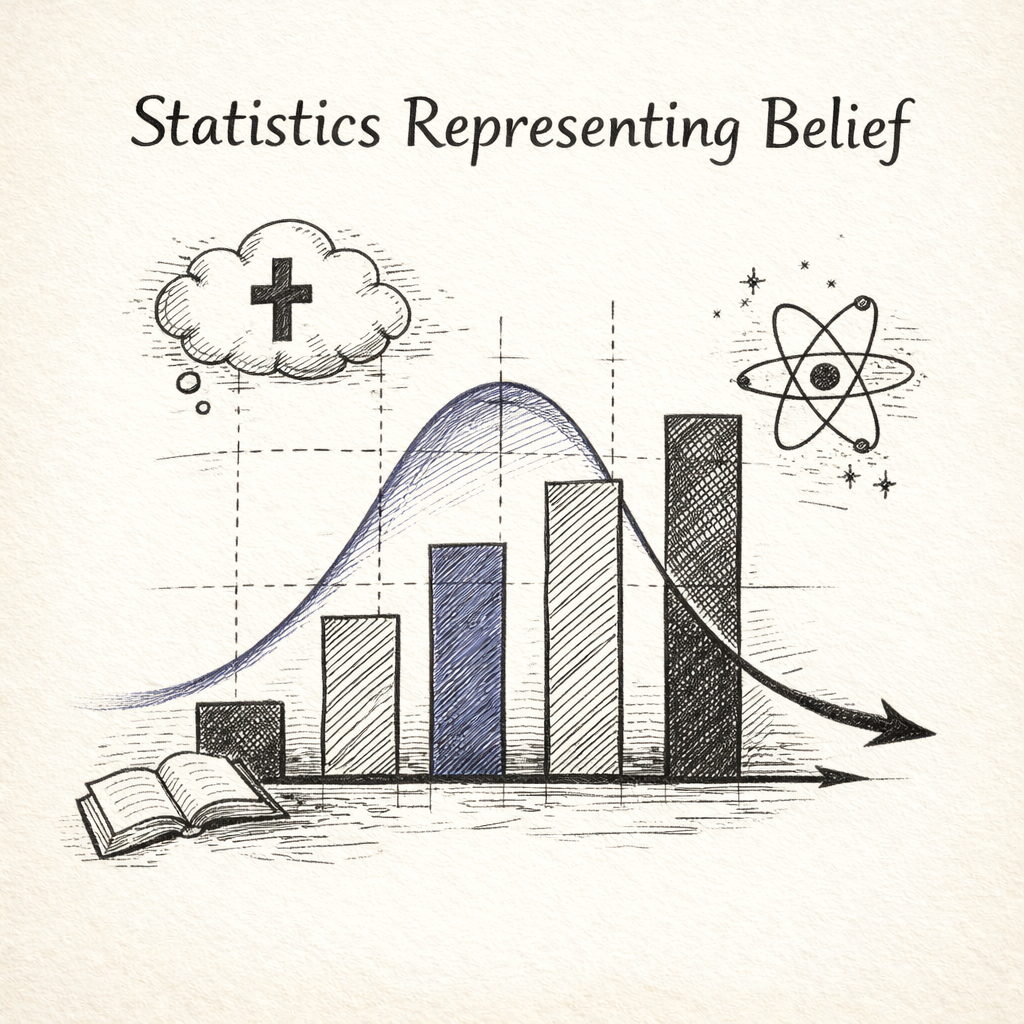
Statistics is not about computing answers.
It is about representing belief.
At its core, statistics exists to answer three questions:
- What do we think is true?
- How confident are we?
- How wrong could we be?
These are architectural questions, not academic ones.
Systems that model belief explicitly can:
- hedge decisions
- delay action
- explore alternatives
- recover gracefully when wrong
Systems that don’t are forced to act as if certainty were free.
It never is.
Statistics as a Design Layer
Seen architecturally, statistics is not a set of formulas.
It is a layer in the system that shapes behavior.
That layer introduces:
- Distributions, not single values
- Variance, not just means
- Confidence, not just predictions
- Calibration, not just accuracy
Each one changes how the system behaves under stress.
Accuracy tells you how often you’re right.
Calibration tells you when to trust yourself.
Only one of those keeps systems alive.
Error Is a Signal, Not a Defect
In healthy systems, error is not hidden.
It is measured, tracked, and learned from.
Error reveals:
- drift in the environment
- mismatched assumptions
- brittle representations
When systems suppress error, they lose contact with reality.
Error is how reality speaks back to the system.
Statistics provides the vocabulary for listening.
The Agentic Perspective
Agentic systems must act without certainty.
They select tools.
They choose plans.
They commit resources.
All of this happens under incomplete information.
Without a statistical view of belief, agents become overconfident actors in fragile worlds. They commit too early, exploit weak patterns, and fail catastrophically when conditions shift.
Statistics gives agents restraint.
- Confidence-weighted decisions
- Risk-aware planning
- Exploration under uncertainty
- Deferred commitment
These are not optional features.
They are the difference between autonomy and recklessness.
An agent that cannot model uncertainty is not intelligent.
It is merely decisive.
And decisiveness without doubt is how systems break.
Once uncertainty is explicit, the traditional ML taxonomy stops being useful.
Closing: Uncertainty Is a Feature
Statistics does not make systems hesitant.
It makes them honest.
In real environments, certainty is rare, noise is constant, and truth is delayed. Systems that acknowledge this survive longer than those that pretend otherwise.
Uncertainty is not a weakness.
It is the raw material of intelligence.