Zepto's updated draft red herring prospectus landed with the SEBI on June 9, 2026. Most coverage will go to the obvious places: the IPO size, the losses, the dark-store count, the valuation.
That is fair. It is also not the most useful signal in the document.
The useful signal is in the operating model. Zepto is no longer presenting itself as a delivery company that happens to run ads. It is presenting itself as an advertising and data platform built on top of neighborhood-level commerce.
In Fiscal 2026, Zepto reported advertising revenue of Rs 1,635.7 crore, up from Rs 651.2 crore the year before. That is 151% growth in a single year, and 2,468 brand partners used its advertising services over that period.
That is not a side business. That is a strategy.
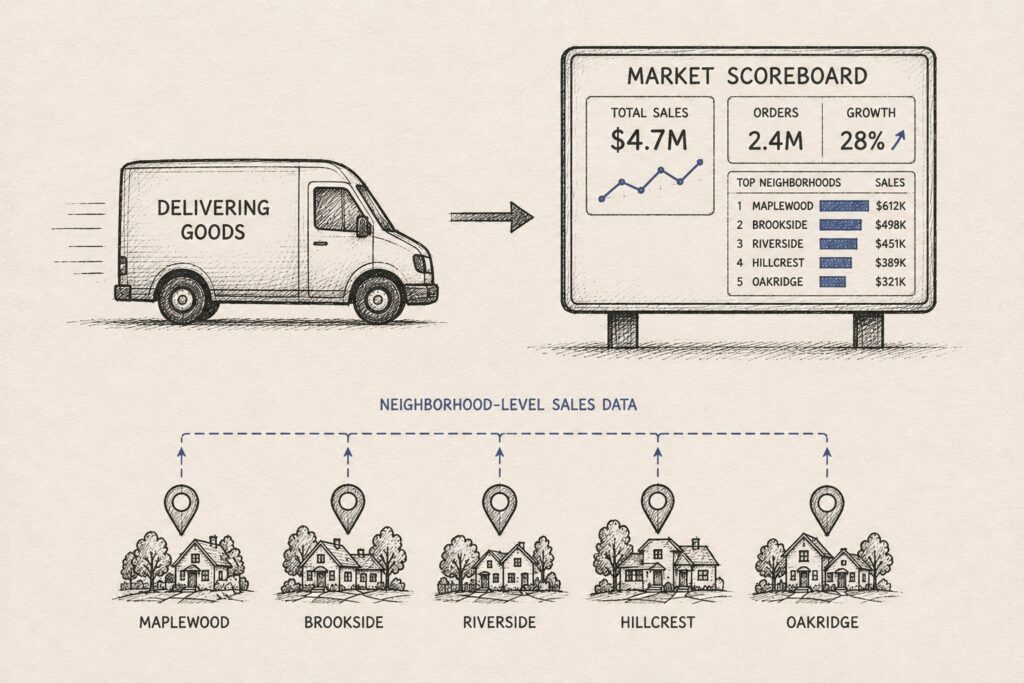
The filing describes an in-house advertising engine: cost-per-click bidding, automated campaign management, keyword suggestions, geo-level consumption patterns. It also describes Zepto Atom, launched in May 2025, which gives brands neighborhood-level market share data, live sales data for their own products, and Zepto GPT, a natural-language interface over Zepto's dataset.
That combination is the tell.
The first quick-commerce product was speed. The second is local market state.
The Delivery Rail Is Becoming A Measurement Rail
Quick commerce started with one promise: fast delivery. Ten minutes was the headline. Dark stores were the operating model. Dense neighborhoods made the unit economics work.
But once the network exists, it produces something more valuable than delivery. It produces a high-frequency record of local demand.
Every search, add-to-cart, stockout, substitution, repeat order, price change, ad placement, and fulfilled order is a signal. Not in a quarterly market report. Not in a monthly sell-through file. In near-real time, at the neighborhood level.
That is the shift. A delivery rail becomes a measurement rail the moment the platform can tell a brand where demand is rising, where share is moving, where availability is choking sales, where a promotion changed behavior, and where a sponsored placement moved rank.
This is what makes quick-commerce retail media different from the advertising that came before it. Search ads know intent, social ads know attention, marketplaces know conversion. Quick commerce knows local purchase pressure under inventory constraints, because the ad impression, shelf rank, inventory position, price, and substitution path all sit next to the same transaction. For a brand, that proximity is powerful.
It also creates a measurement problem when the same platform that sells the media also reports the result.
The Unit Of Competition Is SKU x Neighborhood x Day
Most brand dashboards still aggregate too early. Monthly revenue. Campaign ROAS (return on ad spend, the sales earned per rupee of ad spend). Platform share. City-level performance. Maybe SKU-level sell-through.
That was enough when commerce moved slowly. It is not enough when shelves change by neighborhood and demand moves daily.
The real unit is smaller: SKU by neighborhood by platform by day. Platform is its own axis here, because the same brand sells across Zepto, Blinkit, and Instamart at the same time, each with a different shelf, a different price, and a different ranking model.
At that resolution, the questions change.
Did sales rise because demand grew, or because the SKU was finally back in stock?
Did share improve because the product won, or because a competitor stocked out?
Did paid placement create new buyers, or defend buyers who would have bought anyway?
These are not marketing questions. They are operating questions for commerce. Answering them needs identity resolution across variants, exposure logs, rank history, availability traces, pricing and promotion timelines, competitor context, and repeat-purchase behavior.
That is not a report. It is a control loop.
Zepto Atom Is The Tell
The important thing about Zepto Atom is not the dashboards. Dashboards are table stakes. It is the shape of the data product: the platform is exposing local competitive position, in near-real time, through a queryable interface.
That is the direction every serious brand-analytics product is moving. Brands no longer want another tab. They want to ask why they lost share in one catchment this week, which SKUs gain after 8pm in premium neighborhoods, and where ad spend lifted new buyers instead of subsidizing existing ones. The answer cannot be a generic insight. It has to join campaign, product, inventory, sales, share, price, and availability into a single evidence trail.
This is where AI matters, but only if the data model underneath is sound. An assistant over weak commerce data is just a faster way to produce confident, unsupported explanations. An assistant over clean local market state can actually inspect the loop the brand is trying to change.
Retail Media Turns Into A Proof Problem
Retail media has a structural tension. The platform controls the shelf. It sells visibility on that shelf. It reports whether the visibility worked. In quick commerce, the same platform also sits closest to inventory, checkout, substitution, fees, and product-record quality.
That vertical integration is commercially powerful. It is also what makes a single reported number hard to take at face value.
The pressure is already visible in what brands pay to stay on the shelf. D2C sellers told Storyboard18 that Blinkit charges roughly Rs 25,000 for each SKU in each Indian state it is listed in, a per-product, per-geography fee credited to an ad wallet that expires. One seller put Instamart's listing-and-ad package at Rs 8 to 10 lakh for a quarter. Zepto was described as bundling onboarding, influencer marketing, and ad slots starting around Rs 5 to 6 lakh. Sellers also report a quieter problem underneath the fees: when a brand has to keep topping up ads simply to stay visible, organic retention becomes almost impossible to measure. Platform-reported performance and a brand's own P&L can also diverge for structural reasons. If a dashboard calculates ROAS on MRP, the maximum retail price printed on the pack, rather than the actual selling price after discounts, the two numbers describe the same campaign differently. Neither is wrong. They are measuring different things.
So the measurement question stops being "what was ROAS?" It becomes "who produced the number, what state did it include, and which incentives were baked into it?" That does not make platform measurement useless. It sits close to the transaction, which is what makes it useful. It makes it incomplete. As budgets rise, the harder question is incrementality. Did spend create demand, or shift it from another channel? Did it buy back rank the brand had already earned? Did it mask an availability problem?
That leaves an open question. Who produces the independent number, and how would a brand rebuild platform-reported performance from sources it actually controls, when the platform selling the visibility is also the one scoring it?
In systems terms, the loop never quite closes. The brand acts, the market responds, the platform reports. But the brand cannot independently check that report against the world, so the next decision rests on a number it cannot fully trust. That open loop, not any single fee or metric, is the deeper problem.
When Checkout Becomes Media, Proof Becomes Trust
This is where a media story becomes a trust story.
India's regulators are pulling the same thread from the consumer side. A government-backed self-declaration regime now asks platforms to confirm compliance with dark-pattern guidelines: false urgency, basket sneaking, forced action, subscription traps, drip pricing, disguised advertisements.
Self-declaration is not proof. A June 2026 Datum Intelligence study estimated that dark patterns cost Indian consumers between Rs 25,000 crore and Rs 28,000 crore a year, affecting about 88% of India's 304 million online shoppers, and put more than Rs 55,000 crore in GMV at risk as consumers compare harder and switch. The study assessed 12 major platforms across quick commerce, e-commerce, and travel.
That is the gap. Self-declaration is not proof. Platform ROAS is not incrementality. Checkout conversion is not consumer trust.
If checkout becomes a media surface, the platform's own dashboard cannot be the only record. Brands need numbers they can rebuild themselves: ROAS based on the actual price paid after discounts, not the sticker price; attribution that accounts for whether the item was even in stock; who funded each discount; and whether buyers came back after the campaign ended.
That evidence also has to capture what the listing looked like while the campaign ran. If the price, pack size, or stock status was wrong at the time, every number calculated on top of it is already contaminated, no matter how clean the dashboard looks afterward.
Trust will not come from declaring the platform efficient. It comes from showing which demand was created, which was rented, and which was simply moved.
Signals To Watch
The Zepto filing does not prove every platform will build the same product, or that every brand will trust platform measurement equally. It does prove the category is moving in one direction: quick-commerce platforms are no longer content with delivery fees and commissions. They are monetizing the data exhaust of local commerce.
Three things are worth watching.
First, ad revenue as a share of platform revenue. When ads become material, shelf neutrality gets harder to assume.
Second, the depth of brand analytics. A platform that exposes only campaign ROAS is selling media. A platform that exposes local share, live sales, and queryable datasets is selling market state.
Third, the distance between measurement and execution. The closer the platform sits to price, rank, inventory, and purchase, the harder it becomes to accept a single reported number.
Quick commerce will still be judged on speed, assortment, price, and service. But for brands, the battle is shifting. The question is no longer whether the product is on the app. It is whether the brand understands the local market state well enough to change it.
Delivery built the network.
Retail media monetizes the surface.
Reading that movement, and trusting who reports it, is the part nobody has solved.
The scoreboard is becoming the strategy. The open question is who gets to keep score.
Sources
- SEBI, "Zepto Limited - UDRHP1" filing (June 9, 2026): https://www.sebi.gov.in/filings/public-issues/jun-2026/zepto-limited-udrhp1_101929.html
- Storyboard18, "Zepto clocks over 2x growth in advertising revenue to Rs 1,636 crore in FY26" (ad revenue, 151% growth, Zepto Atom): https://www.storyboard18.com/brand-marketing/zepto-ad-revenue-jumps-151-percent-in-fy26-ahead-of-ipo-debut-ws-l-100656.htm
- Storyboard18, "Quick-commerce's ad fee toll" (Blinkit per-SKU per-state fee, onboarding economics): https://www.storyboard18.com/brand-marketing/quick-commerces-ad-fee-toll-are-platforms-squeezing-out-small-d2c-brands-73952.htm
- Business Standard, Datum Intelligence dark-patterns study (June 2026): https://www.business-standard.com/industry/news/dark-patterns-cost-indian-online-shoppers-up-to-28-000-cr-a-year-study-126060900878_1.html
- PIB, dark-pattern self-declaration release (Nov 2025): https://www.pib.gov.in/PressReleasePage.aspx?PRID=2191948
- Lyxel&Flamingo, q-commerce funnel guide (ROAS-on-MRP mechanic): https://lyxelandflamingo.com/blogs/third-party-marketplaces/winning-on-quick-commerce-high-conversion-funnels-blinkit-zepto-instamart/
Note: Platform fee and onboarding figures are seller-reported via Storyboard18. The ROAS-on-MRP point comes from an agency guide and is treated as operator context, not platform disclosure.