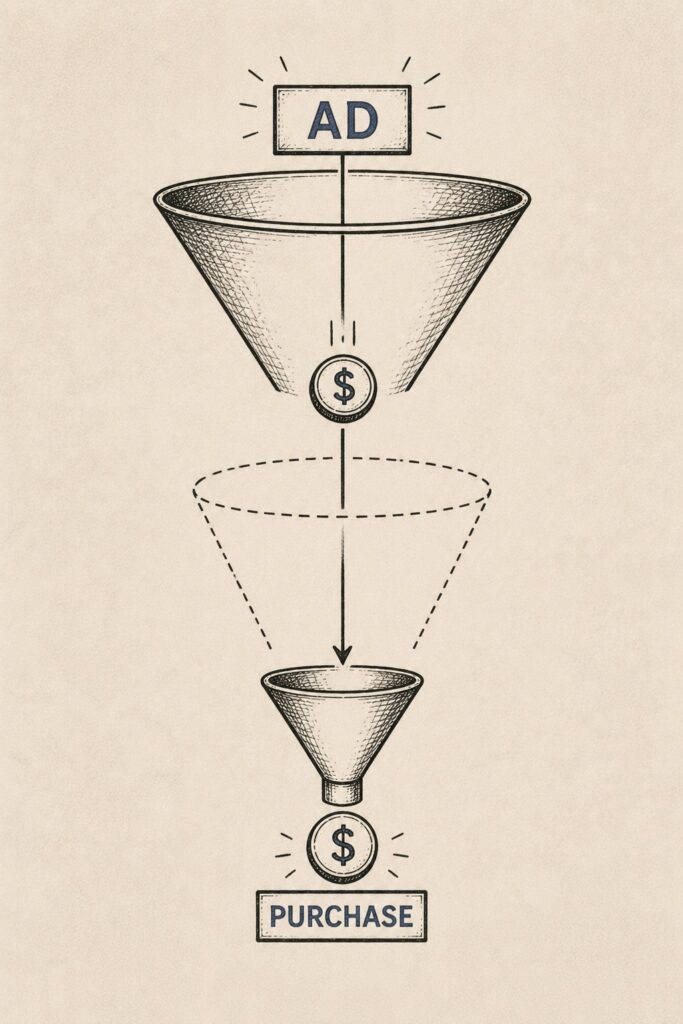
A brand's growth team can usually tell you, close to the decimal, how a customer traveled from an ad to a purchase. Which impression, which click, which touch earned the credit. That visibility is the ground the whole apparatus stands on: retail media budgets, attribution models, the monthly performance review where someone traces a conversion path and decides where next quarter's money goes.
Trusting that path is a reasonable instinct. It has worked, more or less, for fifteen years. Every time the ground shifted, when cookies wobbled, when tracking got harder, the industry answered with better instrumentation and carried on.
Now watch what happens when the shopper is not a person.
I have spent enough time building agents to notice how differently the buying journey runs when one is in the loop. The person is still there at the end, confirming the order, the shipping, the payment. But the middle, the considering and comparing, the scrolling past the sponsored row, increasingly happens on the agent's surface rather than the retailer's. The retailer used to own that middle and instrument every second of it. A growing share of it now happens somewhere the retailer cannot see.
That is not a tracking gap. It is the slow migration of the thing tracking was built to measure.
What is actually happening
This is not hypothetical anymore. Over the past year the plumbing for agent-driven purchases has been laid down quickly. OpenAI and Stripe shipped a protocol for buying inside ChatGPT and began onboarding Shopify merchants, with a transaction fee attached. Google announced a competing standard, developed with Shopify, Etsy, Wayfair, Target, and Walmart and endorsed by more than twenty ecosystem partners. Amazon stayed out and is building its own shopping agents instead. NIQ, in the spring, put the shift in a single sentence: AI is beginning to decide what consumers buy.
The lawyers have arrived too, which is usually the sign that something real is at stake. A federal judge issued a preliminary injunction blocking one company's shopping agent from operating inside Amazon's logged-in experience, and the order was stayed briefly to let the company seek relief on appeal. The visible fight is over who gets to let an agent act on a platform. Underneath it sits a quieter question nobody is litigating: when the agent does act, who can see what happened?
The observer left
Here is the claim, stated plainly.
Every measurement system in commerce, attribution, retail media, conversion analytics, was built on one assumption: the consideration happens on a surface the retailer owns, and the attention there is observable. The pixel that fires when a page loads. The click. The dwell time. The path between search and checkout. All of it is instrumentation pointed at attention on the retailer's own property.
Agentic commerce moves that consideration onto a surface the retailer does not own. The person still confirms the purchase, but the comparing and the deciding increasingly happen inside the agent, where the retailer's pixel does not fire, the dwell time is not theirs to read, and the reason the purchase happened is whatever the agent chooses to surface. The signal did not get noisier. It moved to property the retailer cannot instrument.
Attribution was never really measuring purchases. It was measuring attention, and attention is quietly leaving the surfaces built to observe it.
The reasonable-looking trap
The natural response, the one I would have reached for a few years ago, is to treat this as an instrumentation problem. If the agent is the new intermediary, instrument the agent. Get it to report which products it considered, which placement it saw, what tipped the decision. Put the pixel back one layer up.
It is a reasonable move, and it will produce numbers. It also aims one layer too high, for two reasons.
The first is that a growing share of the signal never lands on the retailer's surface at all. The dwell time that used to happen on the product page is not theirs to read when the comparing happened inside the agent. You cannot instrument attention that occurred on someone else's property.
The second is that whatever the agent does report, it reports on its own terms. The agent is the node that sees the most of the path from intent to purchase. Every platform sees its own slice. The advertiser sees a conversion stripped of context. The actor with the fullest picture is an intermediary optimizing its own objective, and it surfaces exactly what it chooses to. That is not a fidelity gap you close with a better tag. It is a change in where the ground truth lives.
Why this is a state problem, not a tracking problem
I evaluate systems with a framework I call SRAL: State, Reason, Act, Learn, and it is useful here because it names exactly what breaks.
Attribution is a Learn loop. It observes what happened, assigns credit, and feeds that back into where the next dollar goes. That loop depends on a State signal: observed human attention. Agentic commerce does not just add noise to that signal. It moves the observable state onto an intermediary that reveals only what it chooses to.
One principle I keep returning to is that reasoning depth cannot exceed state stability. A system cannot draw good conclusions on top of a state it cannot read. Attribution is about to run into that wall at full speed. You cannot measure your influence over a decision whose state you can no longer observe. The dashboards will keep populating, because dashboards always populate. What they are counting will quietly stop being what they think it is.
This is the same fracture I traced from a different angle in quick commerce, where the platform running the transaction also owns the scoreboard. Different setting, the same structural failure: the thing doing the measuring loses its grip on the thing being measured.
Nobody is the villain here
It is tempting to read this as platforms hoarding data, and worth resisting. The divergence between what gets reported and what actually drove a purchase is not bad faith. It is what the architecture produces. When an intermediary sits between intent and action, the market observes the intermediary's behavior, not the human's preference. Each platform reports honestly on the slice it can see. The trouble is that no slice is the whole, and the whole now lives inside an agent.
That points at the deeper version of the problem. When an agent buys on someone's behalf, "consumer behavior" starts describing the agent's policy rather than the person's preference. Segmentation built on the idea that people differ from one another degrades when a handful of agent architectures mediate millions of purchases. The label on the metric stays the same. What it counts has changed underneath it. That is a longer argument, and probably its own piece.
What this is not
Let me be precise about the claim, because it is easy to overstate.
This is not the death of measurement, and it is not a forecast that agents take over shopping next quarter. Adoption is early and genuinely contested, which is what the courtroom fight is about. A great deal of commerce will stay human and observable for a long time.
The claim is narrower and, I think, harder to wave off. For the slice of commerce that goes agent-mediated, and that slice is being built out deliberately by the largest companies in the market, the assumption under the entire measurement stack, that the consideration happens on a surface the retailer can see, is being eroded. That has not been reconciled with anything. The budgets, the attribution models, and the retail media rate cards still assume an observer who is on the way out of the room.
The dashboards will still be full
The unsettling part is how normal it will look. Nothing goes dark on a screen. The conversion numbers keep arriving, the attribution reports still render, the quarterly review still has its charts. A measurement system does not announce that its ground truth has thinned. It keeps reporting, with the same confidence, on attention that is increasingly happening where it cannot look.
The industry spent fifteen years learning to see the path from attention to purchase. It is about to spend the next few finding out what those numbers count once the shopper is no longer the only one doing the looking.
The observer left.
Sources
- OpenAI, Instant Checkout / Agentic Commerce Protocol. https://openai.com/index/buy-it-in-chatgpt/
- Agentic Commerce Protocol specification. https://github.com/agentic-commerce-protocol/agentic-commerce-protocol
- Stripe, developing an open standard for agentic commerce. https://stripe.com/blog/developing-an-open-standard-for-agentic-commerce
- Google, Universal Commerce Protocol announcement (2026), co-developed with Shopify, Etsy, Wayfair, Target, and Walmart. https://blog.google/products/ads-commerce/agentic-commerce-ai-tools-protocol-retailers-platforms/
- Amazon v. Perplexity preliminary injunction (Mar 10 2026), via GeekWire. https://www.geekwire.com/2026/judge-blocks-perplexitys-ai-bot-from-shopping-on-amazon-in-early-test-of-agentic-commerce/
- Retail media networks and AI agents, PYMNTS (2026). https://www.pymnts.com/news/artificial-intelligence/2026/retail-media-networks-evolve-ai-agents-shop/
- NIQ, "AI Is Beginning to Decide What Consumers Buy" (Apr 28 2026). https://www.businesswire.com/news/home/20260428841965/en/NIQ-Research-Reveals-New-Rules-of-Commerce-AI-Is-Beginning-to-Decide-What-Consumers-Buy
- Reusens, Goethals, Martens, "LLM Consumer Behavior Theory," arXiv:2606.18005 (Jun 16 2026). https://arxiv.org/abs/2606.18005
The figures here are reported by the vendors and analysts cited, not independently verified. Read them as directional.