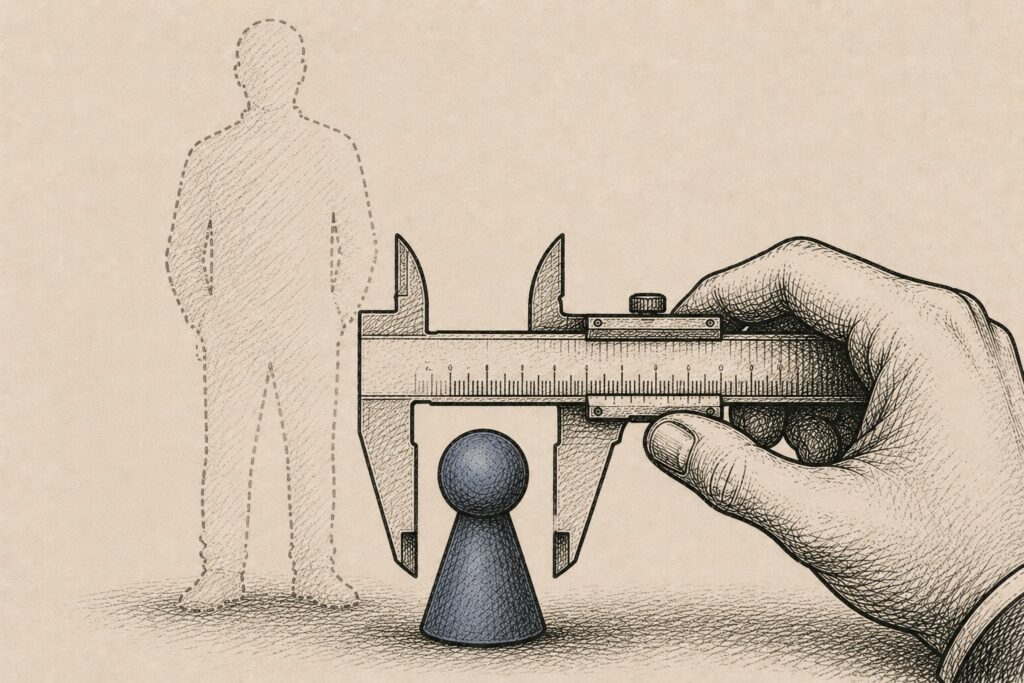
I wrote recently that agentic commerce takes the observer out of the buying journey: the human stops being the one watching the path from ad to purchase, so the signals attribution was built on start to thin. That was the first half of the problem, and it was the visible half. This is the quieter half, and I think it is the one that matters more.
The two can sound like the same complaint, so here is the difference. Losing sight of the buyer is a visibility problem. Picture a security camera in a store going dark: the shopper is still shopping, you just cannot see what they looked at, and in principle better instrumentation puts the camera back.
The quieter problem is not that one. Picture the shopper instead sending a personal assistant to do the buying for them. Now the camera works perfectly, and it is filming the assistant's choices, not the shopper's wants. A better camera does not help, because you are watching the wrong person. That is the shift happening underneath: the buyer you are trying to measure is no longer the one making the decision, so no amount of instrumentation reaches them.
The assumption under every consumer metric
Almost everything we use to understand demand rests on one assumption, so basic it usually goes unstated. A purchase reflects a person's preference. Someone wanted the thing, weighed it against the price, and chose. Segments, personas, price elasticity, brand affinity, the whole apparatus of consumer insight is a way of inferring what people want by watching what people do.
That assumption is reasonable, and for the entire history of commerce it has been true enough to build on. When someone buys running shoes, you learn something about that person.
Agentic commerce quietly removes the person from the middle of that sentence. When an agent shops on someone's behalf, deciding which product, comparing options, pulling the trigger, the purchase still happens, but it no longer reflects a person weighing a choice. It reflects an agent executing a policy, one built on an imperfect, secondhand model of what the person wants. A paper out of the research community this year makes the formal version of the argument: once you let agents make consumption decisions for users, the foundational assumptions of consumer theory, that buyers are roughly rational, that they differ from one another in stable ways, that their preferences hold still long enough to measure, become unsafe to assume. The paper is careful to note it is arguing this, not empirically proving it. So you keep measuring "consumer behavior," but a growing share of what you are actually measuring is the agent's behavior, not the person's preference.
The market now observes the agent, not the person
Here is the shift, stated plainly. When an agent sits between human intent and market action, the market observes the agent's behavior, not the human's preference. Every downstream measurement inherits that substitution without noticing it.
Run a price test and see demand move, and you may be measuring the agent's decision rule, not anyone's willingness to pay. The agent might drop your product because a competitor edged it out on a spec the agent was told to weight, while the humans behind those agents would happily have paid more and never saw the comparison. The elasticity you just measured is real. It is an elasticity of the agent's policy, and you have filed it under "customers."
This is the deeper cut of a pattern I keep returning to: a measurement can be perfectly precise and still be about the wrong subject. Attribution after agentic checkout observes a real transaction and mislabels its cause. Consumer measurement after agentic buying observes a real decision and mislabels its author.
Heterogeneity collapses toward a few policies
Segmentation has a hidden premise: that people differ from one another in ways that are stable enough to group and infer from. A million shoppers are a million slightly different preference functions, and the art is finding the structure in that variety.
Now imagine more of those million shoppers routed through a handful of agent architectures. The same few models, the same few default prompts, the same training data, mediating decisions that used to expose far more human variation. The variety that segmentation feeds on starts to collapse toward the priors of the agents. The market begins to behave less like a million distinct people and more like a few decision rules wearing a million faces. Whatever systematic leanings those models carry, and every model carries some, get amplified into aggregate demand as if they were a genuine shift in what people want.
Preference stability goes the same way. A person's tastes change slowly. An agent's effective preferences change the moment its context changes, its prompt is retuned, or its model is updated. A vendor can ship a new version and move aggregate demand overnight without a single human changing their mind. To the dashboards, that will look like a sudden swing in consumer sentiment. It will be a software release.
Why this is a state problem, not just a data problem
I evaluate systems with a framework I call SRAL: State, Reason, Act, Learn, and it names the confusion cleanly. The demand signal used to be produced by a person's state, their needs, budget, taste, expressed through a choice. Now a growing slice of it is produced by an agent's Reason and Act: a policy running over a context. Those are different state machines. Reading the second one as if it were the first is not a data-quality issue you can clean up. It is a category error baked into what the number is.
This is the sequel to losing the observer, and it is worse in a specific way. The observer problem says you can no longer see the path clearly. The buyer problem says that even with a perfect view, the thing you are looking at has changed identity. You can rebuild the instrumentation. You cannot instrument your way back to a decision a human is no longer making.
What this is not
Some precision, because the claim is easy to inflate. This is not a claim that all shopping is agent-mediated now. It is early, it is contested, and most purchases are still a person choosing. And it is not a claim that agents are unmoored from human preference; they are trained on human behavior, so they carry a compressed, secondhand version of it. That is exactly the trouble. Compressed and secondhand is not the same as direct, and the compression has a shape: work comparing agent behavior to human subjects has found agents behaving more tidily and rationally than the people they stand in for, smoothing out precisely the messy, marginal behavior that often carries the most commercial signal.
The narrow, defensible claim is this. For the slice of demand that flows through agents, and that slice is being built out deliberately, the standard consumer instruments quietly mismeasure an agent's policy as a person's preference, and no one has reconciled the metrics with that fact.
The question sitting underneath
So the field arrives at a question it has not answered, and mostly has not asked. When the consumer has delegated the decision, what does a "consumer insight" refer to?
You can still compute the segments. You can still run the elasticities and draw the preference curves. They will populate, they will look exactly as they always have, and the quarterly deck will render on time. They will simply no longer be about the people they claim to describe, and nothing on the surface will tell you when that line was crossed.
The observer leaving was the part everyone could see. The buyer leaving is the part that changes what the numbers mean.
The buyer left.
Sources
- Reusens, Goethals, Martens, "LLM Consumer Behavior Theory: Foundations of a Novel Research Field," arXiv:2606.18005 (Jun 16, 2026). https://arxiv.org/abs/2606.18005
- Henning et al., on LLM agents behaving more rationally than human subjects in market-style decisions, arXiv:2502.15800. https://arxiv.org/abs/2502.15800