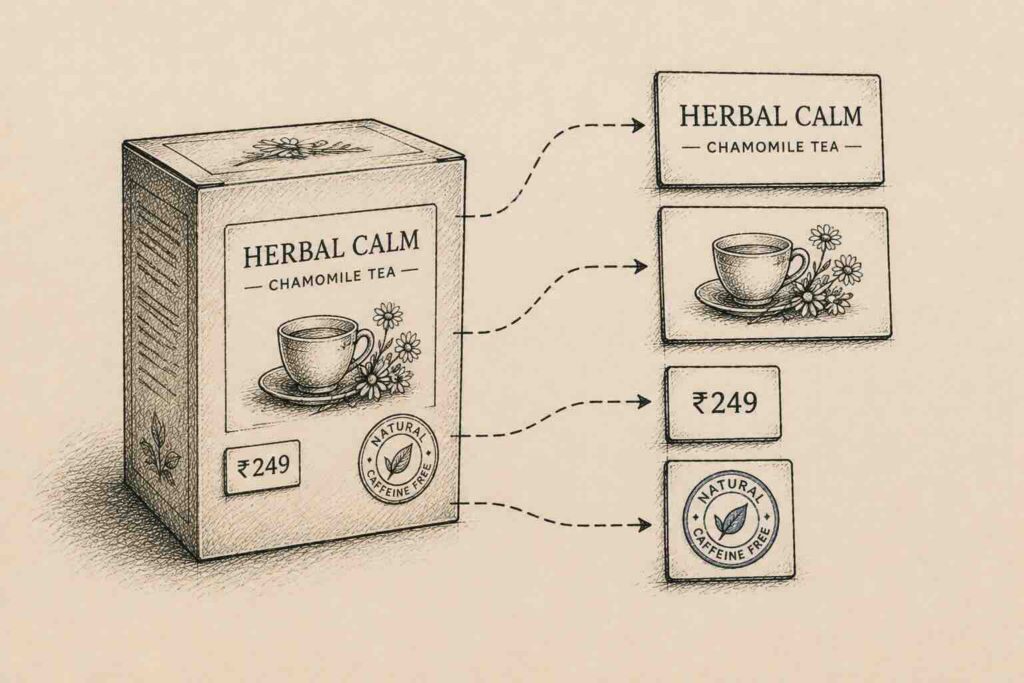
Order a snack on a quick-commerce app and look at what you are actually deciding from. A photo of the pack. A title someone typed into a field. A price. Maybe a bestseller badge, a small offer, a best-before line if the platform chose to show one. You tap buy in a second or two, and a rider brings you a box from a dark store a few streets away.
Here is the quiet thing that has happened. On a real shelf, the product and the truth about it are the same object. You pick up the box, and the name, the weight, the price sticker, and the claim are all printed on the thing you carry to the counter. In quick commerce, that single object has been taken apart into separate software fields. The photo lives in one field, the price in another, the claim in a third, each maintained through its own workflow and updated on its own schedule. The box waiting in the dark store might already be a newer version than the one in the picture.
The label has become live inventory.
In quick commerce, the shelf is no longer just where the product appears. It is where the product is interpreted.
That sounds abstract until you count the ways the screen can quietly stop matching the product. An image lags a packaging change by months. A claim outlives the formulation it described. A badge gets applied by category logic the brand never set. A best-before line is simply missing. None of this needs bad intent. It is just what happens when the thing on the shelf is no longer a physical object but a set of fields that drift.
And the shopper does not experience any of that as separate systems. They see one screen. If the screen is wrong, the brand is wrong, whatever the box in the warehouse actually says. That is the part brands underprice. A stale listing is not a catalog nuisance. It is a live promise being made to a customer in your name, on a surface you do not fully control.
I work on consumer insights for Indian brands, so this is the gap I watch closely: the growing distance between what a platform says about a product and what the product actually is. Quick commerce did not create that gap. It just made it move faster than anyone can check.
A parliamentary report puts the gap on record
On July 23, 2026, a Parliamentary Standing Committee report on packaged food landed in Parliament. The headline was sugar in baby food. The more interesting part sits a few sections deeper, where the committee looked at how food is actually sold on these apps and found that no single body is clearly in charge of the live listing.
Responsibility is split, and the seams are where the gap appears. Nutrition and claims sit with the food regulator, FSSAI. Quantities and price sit with weights-and-measures, Legal Metrology. Ask who is supposed to catch a misleading listing as it goes up, and each points somewhere else. The report does not identify a single cross-agency mechanism for continuously monitoring live listings and coordinating their removal. What exists today is periodic inspections and a monitoring committee. The report recommends building the missing coordination around timely detection, real-time monitoring, and prompt correction of misleading listings.
It is tempting to file this under legal and move on. That is a fair instinct, and it aims one layer too high. A brand can print a fully compliant pack, clear it through legal, and ship it, and that act is a declaration made once, at the factory. It says nothing about the listing a shopper sees three months and one formulation change later, rewritten into a title, an image, and an ad on a platform the brand does not run. A clean declaration filed once is not a measurement of the live thing. The pack complied when it was made. Whether the screen is telling the truth at the moment someone buys is a different question, and it is the one quick commerce has made urgent.
An old problem in a new place
Underneath the regulation, this is a familiar idea. The listing is what the system declares about the product. The pack in the dark store is what is actually true. On a physical shelf they are attached to the same object, so they tend to stay together, even when a tag goes stale. On a digital shelf they are separate fields, so keeping them in sync takes deliberate effort, and what the shopper sees is the declaration.
None of this is an attack on the platforms. Zepto, Blinkit, and Instamart did not set out to make listings unreliable. They did something more consequential almost as a side effect. They turned the shelf into software. A software shelf changes at the speed of a deploy, across many service areas at once. That is the category's whole promise, and it is also why a wrong state now costs more than it used to. A stale listing becomes a live consumer promise in minutes. Speed did not just make delivery faster. It made every field on the shelf a moving target.
So the real signal in a report about sugar labels is this. The shelf is now part of the product, not a picture of it. And on a shelf that changes by the minute, that no brand fully controls, and whose truth no single agency owns end to end, one question is still open. Who is accountable for whether the listing is still true at the moment someone buys?
The box on the shelf used to answer that just by sitting there in your hands. Now it waits out of sight in a dark store, and the screen answers in its place. Whether the screen is right at that moment is a question no single body clearly owns.
Sources
- Standing Committee on Consumer Affairs, Food and Public Distribution (18th Lok Sabha), Fifteenth Report, "Regulation of Packaged Commodities with Specific Reference to Sugar Content in Baby Products and Other Food Products," presented to the Lok Sabha and laid in the Rajya Sabha on July 23, 2026: https://sansad.in/getFile/app/lsscommittee/Consumer%20Affairs,%20Food%20and%20Public%20Distribution/18_Consumer_Affairs_Food_and_Public_Distribution_15.pdf?source=app
- Legal Metrology (Packaged Commodities) Rules: mandatory declarations at the online point of sale (extended to e-commerce by the 2018 amendment), and the 2026 amendment (G.S.R. 128(E), effective July 1, 2026) adding a searchable country-of-origin filter for imported goods (Department of Consumer Affairs notification): https://consumeraffairs.gov.in/public/upload/files/2026.02.13%20PCR%201st%20COO%20Filter%20on%20e-commerce%20websites_1771231030.pdf
- FSSAI compliance requirements for e-commerce food business operators (Press Information Bureau, November 12, 2024): https://www.pib.gov.in/PressReleasePage.aspx?PRID=2072832
- Contemporary coverage of the report's presentation: The Tribune / ANI (July 24, 2026, https://www.tribuneindia.com/news/consumer-protection/parliament-committee-seeks-stricter-monitoring-of-packaged-food-listings-on-e-commerce-platforms) and Business Standard (July 23, 2026, https://www.business-standard.com/industry/news/govt-must-carefully-regulate-sugar-content-in-infant-food-items-par-panel-126072301082_1.html).